When Should You Start Financial Planning?
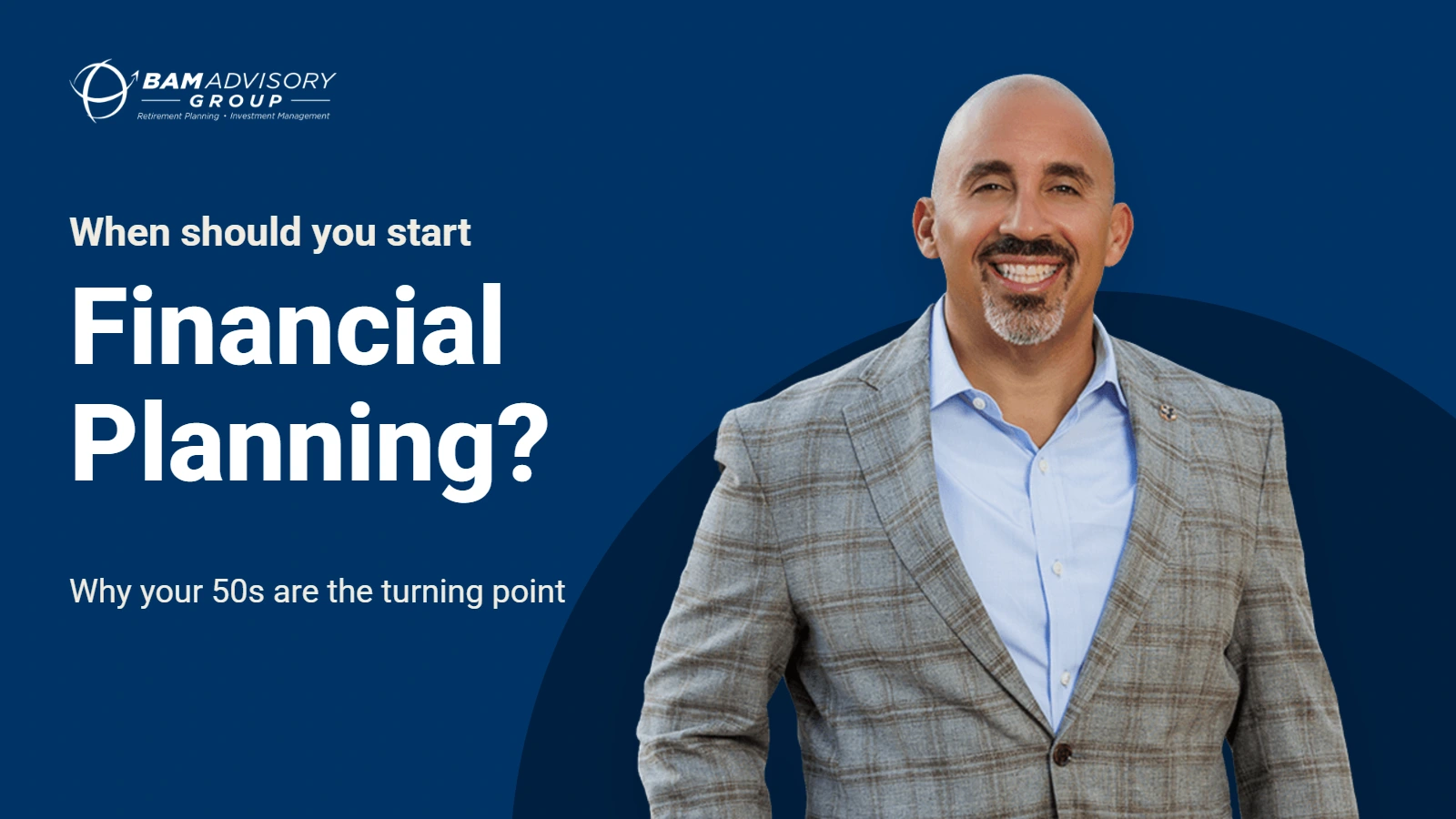
BAM founder David Afraimi explains why saving and planning are two separate jobs, and why your 50s are often the turning point.

With 25+ years of industry experience, David's expertise spans retirement income planning, Social Security maximization, estate planning, and tax mitigation.
We suggest you start saving as soon as you have income, and start real financial planning at least 10 to 15 years before you plan to retire. For many people, that’s the early 50s.
Saving is easier while you have a paycheck. Planning is often harder because withdrawals, taxes, Social Security, Medicare, and required distributions all start showing up around the same time.
Starting sooner helps twice. You get more years of potential compounding and more time to split your savings across differently taxed accounts, which can help reduce what you owe the IRS later.
- Saving and planning are two separate jobs. Saving can run on autopilot in your 20s and 30s, but your 50s are when a real plan starts to matter.
- In our example, investing $1,000 a month from age 35 instead of 45 grew to about twice as much by 65, with $120,000 more in contributions.
- Your 50s open up catch-up contributions: up to $8,000 extra in a 401(k) in 2026, and $11,250 from age 60 to 63.
- A misconception David often runs into is underestimating how much of your savings could go to taxes.
Saving Early vs. Planning Early: Why Both Matter
Many people hear “start early” and think about saving. David doesn’t think you need much help with that part while you’re drawing a salary:
"The time that you can do it yourself is when you're working, because you might just throw it in something like an S&P index fund or your 401(k) and you have a paycheck from your employer. You may not need to hire a financial advisor."
David Afraimi
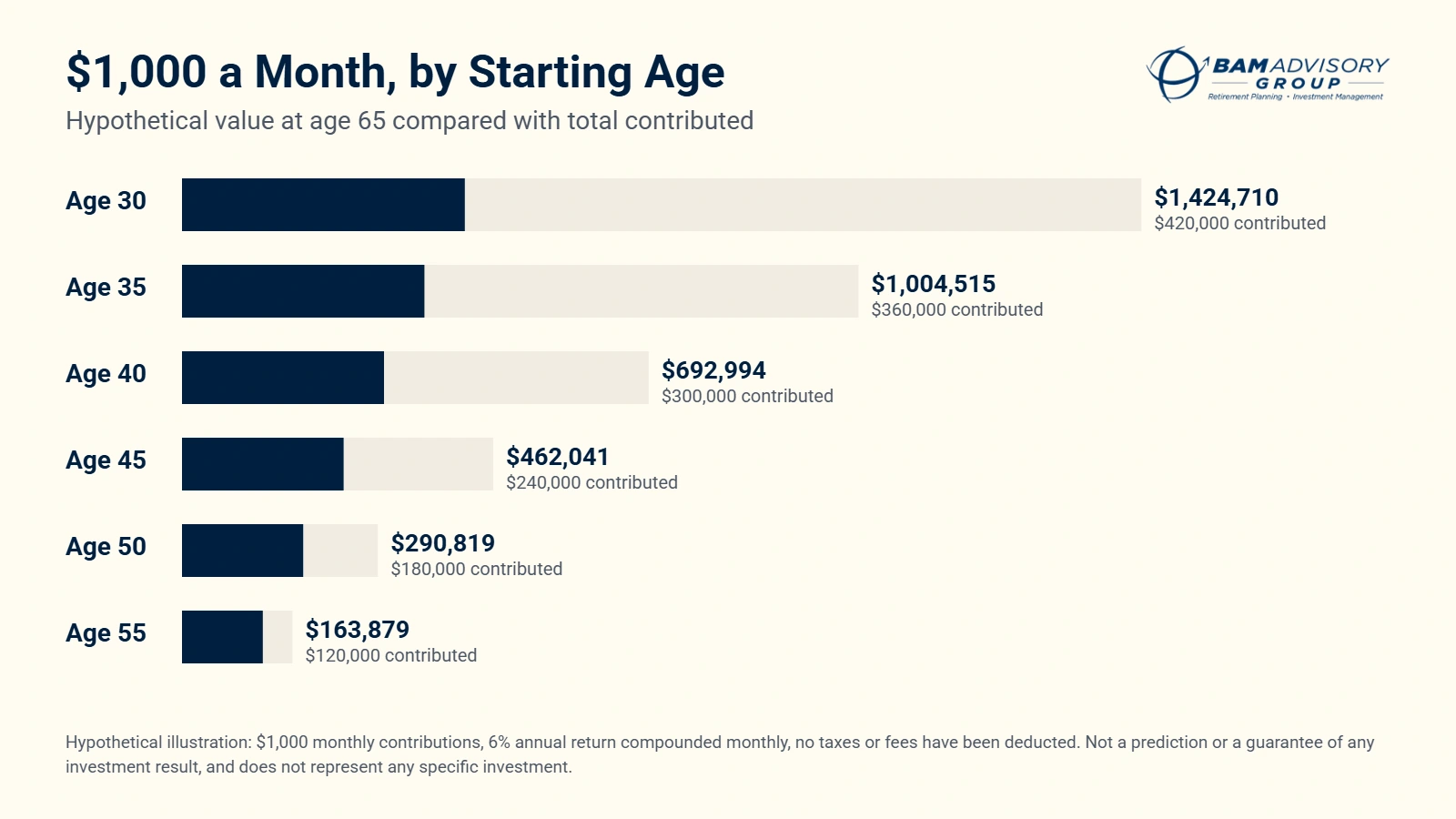
Early saving helps because of time. Assuming a hypothetical 6% average annual return, $1,000 a month grows to these amounts by age 65, depending on when you start:
| Start age | Total contributed | Value at 65 |
|---|---|---|
| 30 | $420,000 | $1,424,710 |
| 35 | $360,000 | $1,004,515 |
| 40 | $300,000 | $692,994 |
| 45 | $240,000 | $462,041 |
| 50 | $180,000 | $290,819 |
| 55 | $120,000 | $163,879 |
Hypothetical illustration: $1,000 monthly contributions, 6% annual return compounded monthly, no taxes or fees have been deducted. Not a prediction or a guarantee of any investment result, and does not represent any specific investment.
Look at the 35 and 45 rows. The earlier starter puts in $120,000 more but ends up with more than $540,000 more at 65.
Planning is another matter. It gets more important, not less, as retirement gets closer.
Why Your 50s Are Often A Turning Point
David talks about this decade as the handoff between your accumulation years and your distribution years:
"Once you cross over 50, often the last chapter of your working years, you need to start positioning your portfolio from accumulation to distribution. We need to start thinking more than just investments: taxes, income, healthcare, long-term care, legacy."
David Afraimi
His team often reviews portfolios for people in their 50s and 60s still carrying the risk they took on in their 30s or 40s. A severe correction then can do real damage.
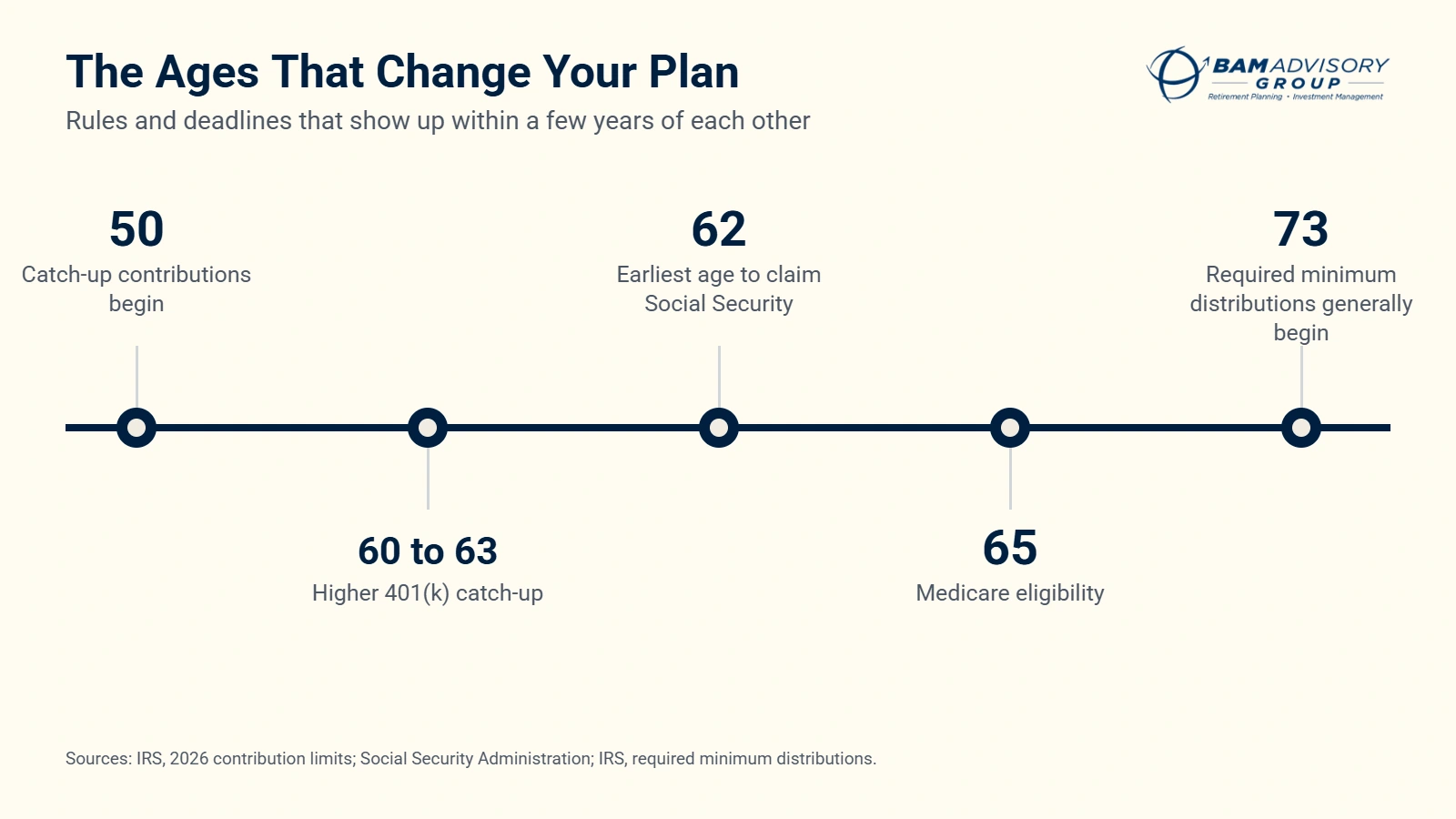
Meanwhile, a handful of rules and deadlines show up within a few years of each other. Each one changes the math on the others.
| Age | What changes | Why it matters for planning |
|---|---|---|
| 50 | Catch-up contributions begin: up to $8,000 extra in a 401(k) and $1,100 extra in an IRA for 2026 | Your last decade to boost and rebalance savings |
| 60 to 63 | Higher 401(k) catch-up of up to $11,250 for 2026 | A short window to save even more |
| 62 | Earliest age to claim Social Security, at a permanently reduced benefit | Claiming early vs. waiting is one of the biggest SS income decisions |
| 65 | Medicare eligibility | If you retire before 65, you need a plan for health insurance |
| 73 | Required minimum distributions generally begin | Pre-tax accounts start forcing taxable withdrawals |
In David’s view, our industry does a fine job of telling people where to put money while they work.
Getting it back out is another story. A plan is built to help cover that withdrawal side.
A Planning Mistake David Often Sees: Waiting on Taxes
We asked David about the biggest misconception people carry into retirement while they’re still working. He said taxes, and specifically how much of a lifetime of savings could end up with the IRS.
"If you're max funding your 401(k), that's going in pre-tax. What people don't realize is that by the time you've approached retirement, and it's over a million bucks, you could be paying more taxes in retirement than you did while you were working."
David Afraimi
He’s quick to say this doesn’t apply to everyone.
It depends on the person. So part of our planning is showing each client a projection of their lifetime taxes, along with the years when they could get stuck in a higher bracket.
His strategy involves tax diversification. Start it early and it has more room to work.
In practice, that can mean sending part of your savings to a Roth 401(k) or Roth IRA.
You pay some tax today, and that money can come out tax-free later. “Yes, you may pay a little bit more taxes now, but that’s often better than later,” he says.
Waiting has a price, and David has watched people pay it:
"The earlier we can help them tax diversify, it's just going to mean the potential for more wealth for them, more money for them to spend, or more they could leave tax efficiently to their heirs."
David Afraimi
You can read more about how our team handles tax planning.
Don't Plan Retirement the Day You Retire
David likes to compare it to planning a trip:
David says many people will create a full itinerary for a trip months before they drive to the airport. "You should create a plan well before the day you're going to retire."
David Afraimi
Putting it off also leaves you at the mercy of timing.
Say the market drops 30% or 40% in your first year of retirement and your income still comes straight out of your investments. You’d be selling while prices are down just to cover the bills. David calls that sequence of returns risk.
Our article on asset management in retirement shows two hypothetical retirees with the same returns who ended up $355,000 apart, only because of when their losses hit.
Signs It May Be Time to Start Financial Planning
- You're 50 or older and nobody has ever shown you a written retirement income plan.
- Much of what you've saved sits in pre-tax 401(k)s or IRAs.
- You couldn't say which account you'd draw from first.
- You'd like to retire before 65 but haven't worked out how to pay for health insurance until then.
- You've told yourself "one more year" more than once.
- Your portfolio carries the same risk it did in your 40s.
Start With a Plan, Not a Guess
If you’re in your 50s or early 60s, a first conversation doesn’t commit you to anything.
Our team walks you through where you stand today, how much of your savings could go to taxes, and what your income might look like once the paychecks stop.
Every BAM Retirement Gameplan™ starts there. So does our approach to retirement planning in Denver.
Frequently Asked Questions
When should someone begin a financial plan?
Begin saving as soon as you earn income, and build a full financial plan at least 10 to 15 years before retirement, usually in your early 50s. That’s when Social Security timing, taxes on withdrawals, healthcare before Medicare and investment risk start to overlap. Starting earlier gives you more years to diversify taxes and correct course.
At what age should you have $100,000 saved?
There’s no single right age, because it depends on your income, expenses and when you started. As a reference point, investing $1,000 a month at a hypothetical 6% return passes $100,000 in about seven years. What matters more than a milestone is having a plan that shows whether you’re on track for the retirement you want.
Is 50 too late to start planning for retirement?
No. Your 50s are when planning matters a great deal. You can make catch-up contributions of up to $8,000 a year in a 401(k) in 2026, and up to $11,250 between ages 60 and 63. You still have time to adjust risk, diversify taxes and build an income plan before you stop working.
How do I start planning for retirement?
Start with two numbers: what you expect to spend each year in retirement, and what income you can count on from Social Security, a pension or other sources. The gap between them is what your savings need to cover. From there, a plan maps out investments, taxes, healthcare and legacy so all of your decisions point toward the same goal.
This article is for informational purposes only and should not be construed as a recommendation, or as financial, legal or tax advice for your particular circumstances.

Maxwell Ross is our Colorado native! His certifications include his Series 65 and Colorado Life & Health License. Having the ability to help reduce the stress and worry people feel about their financial futures is something Max truly sees value and inspiration in.
inView all posts by Max Ross →
David began his financial services career in 1999 as an insurance account executive in Northern California. He expanded operations to Denver, Colorado in 2005, co-founding BAM Advisory Group alongside his wife, Kristy. With 25+ years of industry experience, David's expertise spans retirement income planning, Social Security maximization, estate planning, and tax mitigation.
inMore from David →Related Posts
Asset Management in Retirement
The three-bucket structure we use to help keep your income apart from market swings.
October 6, 2026

High Net Worth Financial Advice
When a basic plan stops being enough, and what changes past $500,000.
October 13, 2026

How Can You Stop Worrying About Running Out of Money in Retirement?
Five steps that can help you trade uncertainty for a written income plan.
October 27, 2026