
Asset Management in Retirement
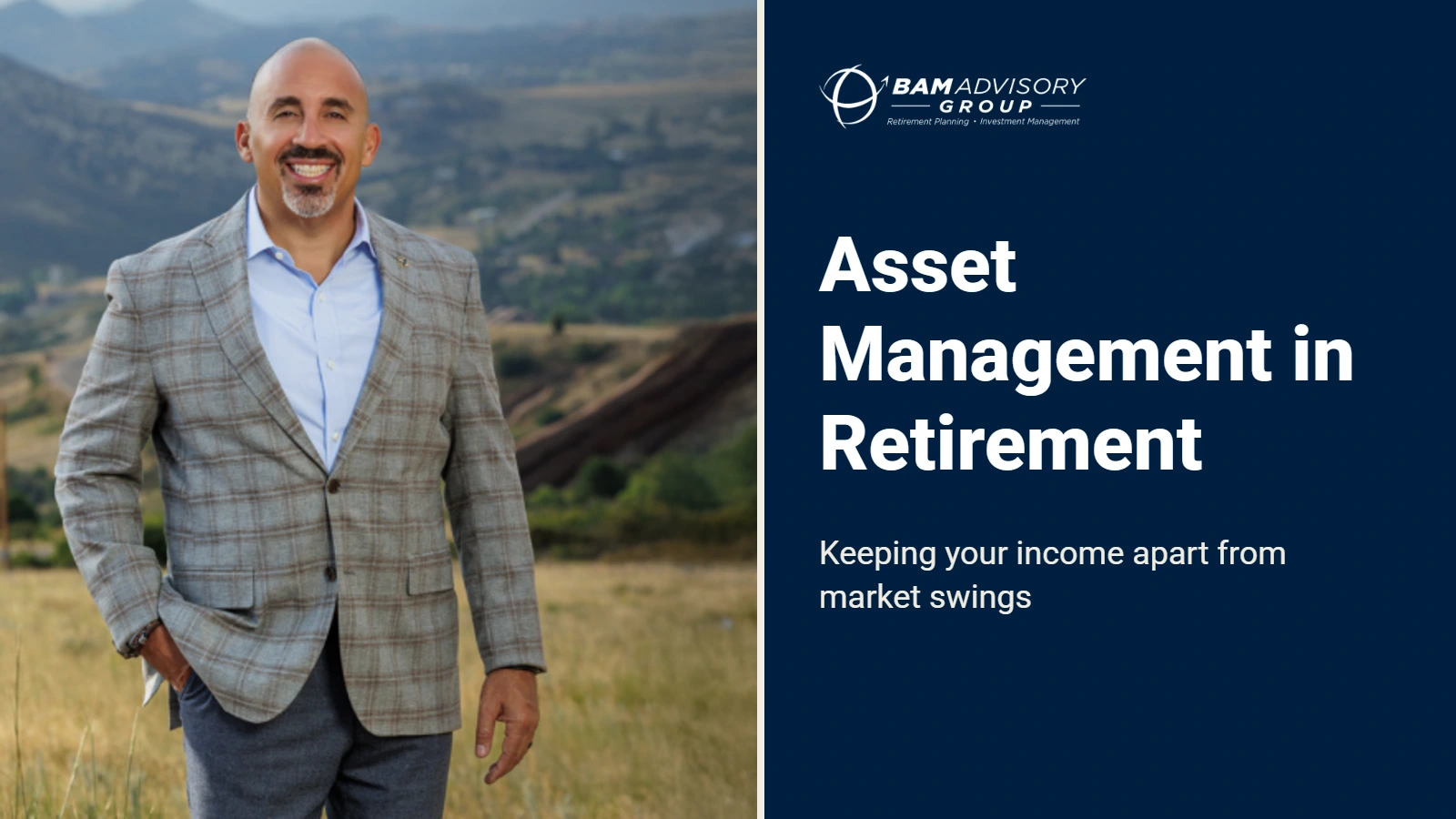
BAM founder David Afraimi walks through the three-bucket structure we use to help keep your income apart from market swings.

With 25+ years of industry experience, David's expertise spans retirement income planning, Social Security maximization, estate planning, and tax mitigation.
Asset management in retirement is the process of organizing your investments so they can pay you a reliable income while the rest of your money keeps growing.
What changes in a big way from your working years is simple.
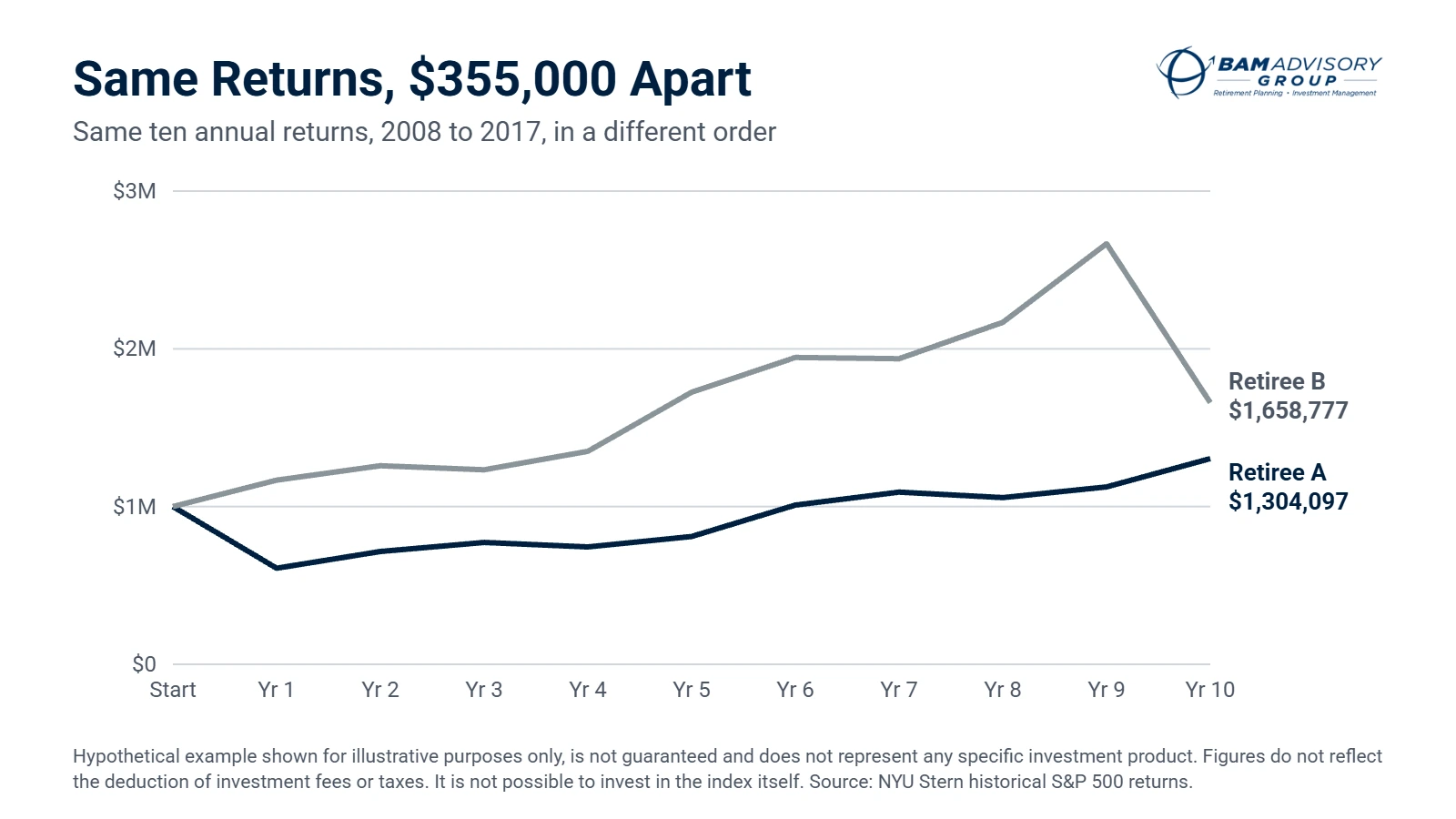
You’re taking money out now. Once withdrawals start, an early market drop in retirement can do damage that lasts for years. We ran real S&P 500 returns in a hypothetical example to see the difference this could make. Put the same ten years of returns in a different order, and one retiree ends up $355,000 behind another.
BAM founder David Afraimi walks through the three-bucket structure we use to help keep your income apart from market swings. He also covers how we measure real risk and the mistakes he often finds in self-managed portfolios.
- Retirement is often the first time withdrawals and market volatility may hit together, and that pairing can drain portfolios faster than anticipated.
- Using real S&P 500 returns, the same 10 years in a different order in our hypothetical example leaves one retiree $354,680 behind the other.
- A label like "conservative" tells you very little about risk. A stress test of what you actually own tells you a lot more.
- Keeping protection, income, and growth separate is a strategy we use to help ensure you won't be forced to sell low to cover your bills.
- Self-managed mistakes we often see are too few holdings, risk that never gets adjusted, and taxes nobody needed to pay.
Why Asset Management Changes in Retirement
For 30 or 40 years, your portfolio had one job. Grow.
You put money in and mostly left it alone. A bad year didn’t affect your mortgage payment because a paycheck kept coming in.
Then you retire, your portfolios job changes overnight. David Afraimi, who founded BAM Advisory Group in 2005, puts it this way.
"This is the first time in a retiree's life that two things may collide at the same time: money distributions and market volatility."
David Afraimi
| Working years (accumulation) | Retirement (distribution) | |
|---|---|---|
| Portfolio's job | Grow | Pay you, then grow |
| Cash flow | Money goes in | Money comes out every month |
| A market drop means | Buying at lower prices | Possibly selling at a loss |
| Big risk | Not saving enough | Sequence of returns risk |
| Taxes | Often deferred | Due on every pre-tax dollar you withdraw |
David says a portfolio he often sees is one that never made that switch.
“I can’t tell you how many times we analyze portfolios where people are taking on the same level of risk in their 50s and 60s that they did in their 30s and 40s. A severe market correction could devastate someone.”
Same Returns, $355,000 Apart: What Sequence of Returns Risk Could Look Like
Sequence of returns risk is the risk that market losses show up early in retirement, while you’re withdrawing money, and permanently cut how long your savings last.
We wanted to see it with real data, so we ran the numbers using actual S&P 500 total returns (NYU Stern historical S&P 500 returns).
Picture two hypothetical retirees. Each one starts with $1,000,000, takes out $40,000 in year one, and raises that withdrawal by 3% a year to keep up with inflation.
They get the exact same ten annual returns from 2008 through 2017, which averaged 10.3% per year. Only the order is different.
| Year | Retiree A: 2008 to 2017 in order | Retiree B: same returns, reversed |
|---|---|---|
| 1 | $609,120 (the -36.6% year) | $1,167,456 |
| 2 | $715,238 | $1,258,816 |
| 3 | $772,512 | $1,233,166 |
| 4 | $744,108 | $1,350,272 |
| 5 | $810,172 | $1,724,890 |
| 6 | $1,009,363 | $1,945,236 |
| 7 | $1,091,610 | $1,937,321 |
| 8 | $1,056,800 | $2,167,946 |
| 9 | $1,124,551 | $2,666,496 |
| 10 | $1,304,097 | $1,658,777 (the -36.6% year) |
| Total withdrawn | $458,555 | $458,555 |
Hypothetical example shown for illustrative purposes only, is not guaranteed and does not represent any specific investment product. Figures do not reflect the deduction of investment fees or taxes. It is not possible to invest in the index itself.
Retiree B took the same 36.6% loss. It just landed at the end instead of the start, and B still finished $354,680 ahead.
After the hole dug in year one, Retiree A spent five years below the starting balance. With larger withdrawals or a weaker decade, that hole might never close. Every withdrawal during that bad stretch meant selling shares at low prices.
Neither one picked their timing. Your retirement income plan shouldn’t hinge on it.
Want to see your own sequence risk? Schedule a call, and we’ll run your portfolio through a 2008-style market.
How We Organize Your Assets: The Three-Bucket Approach
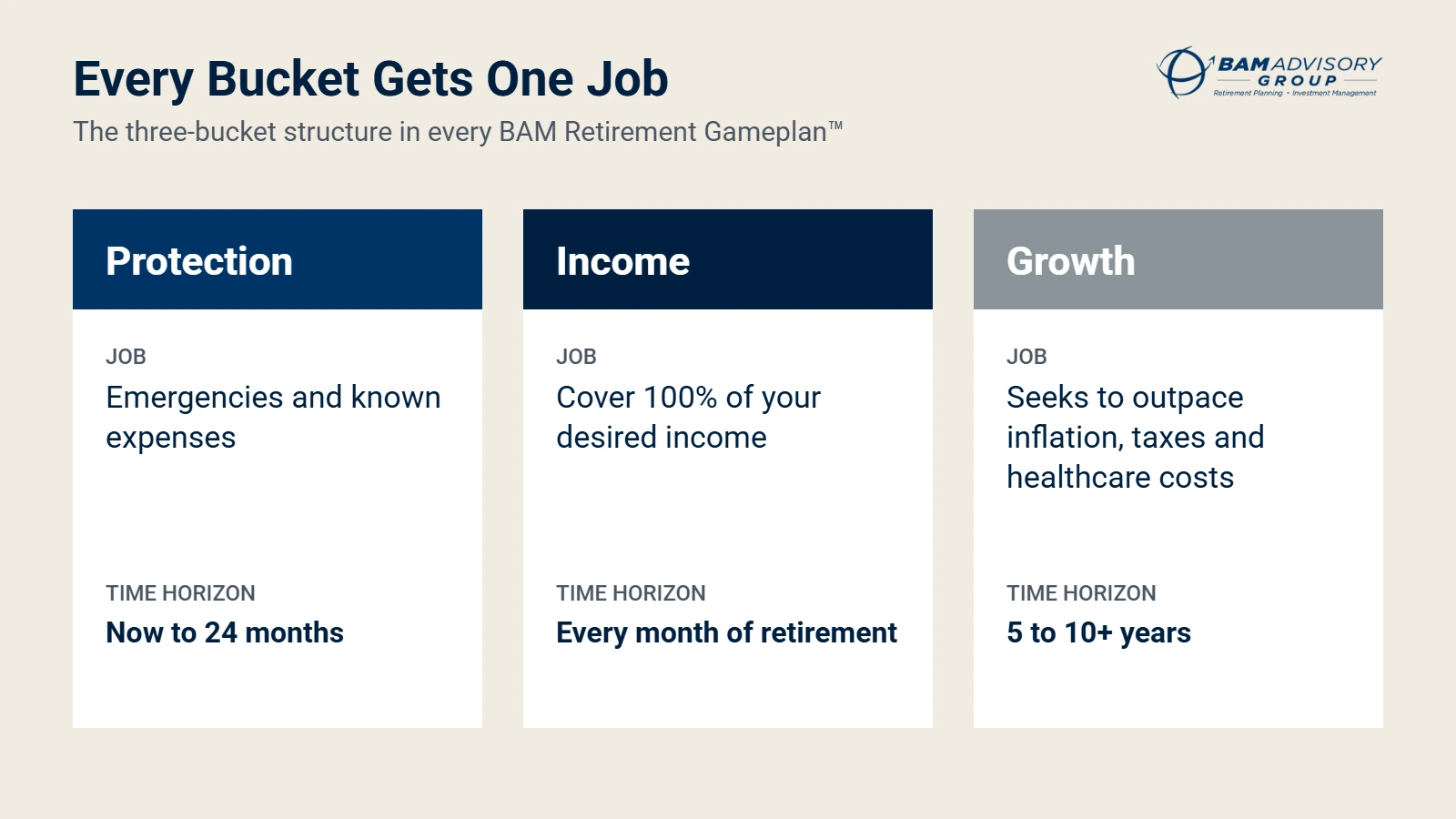
Every BAM Retirement Gameplan™ splits your assets into three buckets. Each bucket gets one job.
Keeping those jobs separate helps prevent a bad market from turning into an income problem.
| Protection | Income | Growth | |
|---|---|---|---|
| Job | Emergencies and known expenses | Cover 100% of your desired income | Seeks to outpace inflation, taxes and healthcare costs |
| What it holds | Cash and cash alternatives | Social Security, pensions, annuities, dividends, rental income, bonds | Long-term investments |
| Time horizon | Now to 24 months | Every month of retirement | 5 to 10+ years |
| Market exposure | None | Limited; income doesn't depend on selling investments | Yes, with time to potentially recover |
Bucket 1: Protection
This is money for emergencies, plus purchases you can already see coming, like a car or a down payment. David is blunt about where it belongs.
"Whatever money you think you need for emergencies should be in your cash bucket. You should not have that money in the market, because in the short term markets can be extremely volatile."
David Afraimi
Bucket 2: Income
This bucket is meant to cover 100% of your desired income, needs and wants both, in a way that’s “reliable, predictable, dependable, and generally not tied to the stock market.”
Depending on the client, that can include Social Security, a pension, annuities, dividends, rental income and bonds.
Annuity guarantees are backed by the claims-paying ability of the issuing insurance company.
We also look at whether your income plan holds up when something outside your control changes. Social Security is the obvious one.
The 2026 Social Security Trustees Report projects the combined trust funds can pay full benefits until 2034. After that, ongoing income would cover about 83% of program costs (2026 Social Security Trustees Report).
David often asks new clients whether they have a plan for a Social Security cut.
Many don’t. So we plan for a reduced benefit instead of hoping it never comes.
Bucket 3: Growth
This is money you won’t need for five to ten years or more. It is invested more aggressively, and has the potential for market losses.
It stays invested because inflation, taxes and healthcare keep getting more expensive.
It’s also the only bucket where we expect real volatility. But since it isn’t funding your paycheck, it has time to potentially recover.
Our guide to the three-bucket strategy for a secure retirement goes through each bucket in more detail.
How We Measure Real Risk in a Retirement Portfolio
Ask people how much risk they’re comfortable with and nearly all of them answer with one word. Usually it’s conservative, moderate, moderate plus, or aggressive.
"People come in and say, I'm conservative, my advisor knows I'm conservative. But when we analyze their portfolio, they've got a $3 million portfolio at risk. That's aggressive."
David Afraimi
So we don’t bother with the label. We test the portfolio.
Our Retirement Analysis shows what your current holdings could lose if we went through another 2008 and 2009. David says plenty of people who come in haven’t adjusted their risk since that crash.
Then comes a blunter question. If you have $1 million, how much would you have to lose in 12 months before you panic?
Say the answer is 20%. Then we design the portfolio around that limit, not around one that could fall 50%.
The math on losses is lopsided:
| If your portfolio drops | It needs this gain to get back to even |
|---|---|
| 10% | 11.1% |
| 20% | 25.0% |
| 30% | 42.9% |
| 40% | 66.7% |
| 50% | 100.0% |
And those numbers assume no withdrawals.
Pull income out during the recovery and the climb gets steeper.
David is upfront about the cost, too. A portfolio built to limit losses may capture less of a strong market’s upside.
He usually puts it to clients as a question. “What’s more important to you, the amount of money you make or how much you lose?”
Risk also creeps up quietly.
After a few strong years, the growth bucket can get riskier simply because it got bigger. So the first thing we review at every client meeting is your current potential drawdown.
If that number is more than you’re comfortable with, we reposition. In some cases we’ll use strategies with built-in downside buffers on part of the growth bucket.
What Happens to Your Retirement Income When the Market Drops
Because the income bucket doesn’t depend on selling investments, a downturn generally doesn’t change what our clients receive each month.
It’s investors without that separation who may get hurt.
“If you’re just withdrawing from your investments to satisfy income and the markets are bad, you’re now selling investments that are low,” David explains. “That’s how you may run out of money faster.”
With income coming from its own bucket, the growth money can sit through the downturn and it has the potential to recover. It doesn’t have to be sold at a loss to meet your basic expenses.
Running out of money is a fear plenty of retirees can’t shake. If that’s you, read How Can You Stop Worrying About Running Out of Money in Retirement?
5 Mistakes We Find in Self-Managed Retirement Portfolios
Things look different after 50.
That’s roughly when people start moving from saving to spending, and the mistakes get more expensive.
| Mistake | Why it hurts in retirement | What we do instead |
|---|---|---|
| 1. Too much in too few stocks | When three or four stocks make up much of a portfolio, one bad year at one company can change your whole net worth. Research on nearly 30,000 U.S. stocks from 1926 to 2025 found that just 46 companies accounted for half of the $91 trillion in net stock market wealth created, so a few picks can easily miss the winners. | Diversify* so no single position decides your retirement |
| 2. Emotional attachment | Holding a stock because of how you feel about the company, not the job it does in your plan | Every holding has to earn its place in a bucket |
| 3. Unnecessary taxes | Frequent trading that can trigger short-term capital gains | Coordinate trades with your tax plan |
| 4. Risk that never changed | The same allocation from your 40s into your 60s, often unreviewed since 2008 | Stress test and review drawdown risk every year |
| 5. A rule of thumb instead of a plan | "Don't withdraw more than 4%" ignores taxes, timing and sequence risk. In David's words, "That doesn't work." | A defined income plan funded by the income bucket |
Source: Bessembinder, “One Hundred Years in the U.S. Stock Markets,” Arizona State University, March 2026 *Diversification does not ensure a profit or guarantee against losses.
David compares the difference to driving. “There’s a reason the windshield is bigger than the rearview mirror. You can see where you’re going and you can see something before it becomes a problem.”
Some advisors, in his view, steer by the rearview mirror. They meet once or twice a year, and the whole conversation is about what the market already did.
Asset Management Works Better as Part of One Plan
Asset management is one of five areas in every BAM Retirement Gameplan™. The other four are income, taxes, healthcare and long-term care, and legacy.
They aren’t handled in isolation. A move in one usually ripples into the rest.
Taxes may show it best.
Many of the people we meet keep the bulk of their savings in pre-tax 401(k)s and IRAs.
David has watched clients with $1 million to $2 million or more realize they may keep only about 70 cents on the dollar once withdrawals are taxed.
As he likes to say, “a 401(k) is not a retirement plan, an IRA is not a retirement plan.”
Where each investment sits matters. So does which account you draw from first, and sometimes that order counts as much as what you own.
Self-Check: Is Your Portfolio Built for Retirement?
If you’re within 10 to 15 years of retiring, go through this list and be honest with yourself:
- I know how much my portfolio could lose in a 2008-style market.
- My retirement income doesn't depend on selling investments in a down year.
- I have one to two years of cash set aside for emergencies and big purchases.
- No single stock or sector makes up a big share of my savings.
- I know which accounts I'll withdraw from first, and why.
- My allocation has changed since my 40s.
- I have a plan if Social Security benefits get reduced.
If you can’t say yes to at least five, there’s a fair chance your portfolio is still built for accumulation.
Find Out What Your Portfolio Is Really Built For
We’ve been at this since 2005. From our Lakewood and Highlands Ranch offices, our team helps clients turn their savings into a three-bucket plan that pays them predictable income.
We’ll stress test the portfolio you have today and show you what it could lose in a downturn. Then we map out your income, taxes and growth potential together, as one plan.
You can read more about our investment management and retirement income planning work, or see how we approach retirement planning in Denver.
Frequently Asked Questions
What is the best asset allocation for a retiree?
There’s no single best allocation. The right mix depends on how much income you need, how much Social Security or a pension already covers, and how large a loss you could tolerate before panicking. We aim to fund your income needs first from sources not tied to the market, then invest the remaining long-term money for growth potential based on a stress-tested risk level.
What is one of the top mistakes retirees make?
One damaging mistake we see is withdrawing from investments during a market decline, which forces you to sell low. In our hypothetical illustration above using real S&P 500 returns, a bad first year left a retiree $354,680 behind someone who had identical returns in reverse order. A separate income source and cash reserve help you avoid it.
What percentage of Americans have $1,000,000 in their retirement account?
Fewer than you might think. In the Federal Reserve’s 2025 Survey of Consumer Finances, about 7% of all U.S. households had $1 million or more in retirement accounts. The share peaks at about 12.4% for households headed by someone 55 to 64, the highest of any age group (Q3 Advisors analysis of the Fed’s 2025 SCF). At that level, taxes, withdrawal order, and risk decisions start to have a much bigger effect on how long the money lasts.
What is sequence of returns risk?
Sequence of returns risk is the risk that poor market returns early in retirement, combined with withdrawals, could permanently shrink your savings even if long-term average returns are good. It usually matters a great deal in the first five to ten years of retirement. Keeping income separate from growth investments can be an effective way to help manage it.
This article is for informational purposes only and should not be construed as a recommendation, or as financial, legal or tax advice for your particular circumstances.

Maxwell Ross is our Colorado native! His certifications include his Series 65 and Colorado Life & Health License. Having the ability to help reduce the stress and worry people feel about their financial futures is something Max truly sees value and inspiration in.
inView all posts by Max Ross →David began his financial services career in 1999 as an insurance account executive in Northern California. He expanded operations to Denver, Colorado in 2005, co-founding BAM Advisory Group alongside his wife, Kristy. With 25+ years of industry experience, David's expertise spans retirement income planning, Social Security maximization, estate planning, and tax mitigation.
inMore from David →Related Posts

Three Bucket Strategy For A Secure Retirement
Retirement planning is not just about accumulating wealth...
November 11, 2024
Income Planning: The Most Vital Piece In Retirement
Retirement is supposed to be the golden period of life...
November 11, 2024
3 Biggest Mistakes That Can Derail Your Retirement
Planning for retirement is more than just saving money...
November 11, 2024