How Can You Stop Worrying About Running Out of Money in Retirement?
Max Ross shares five steps that can help you trade uncertainty for a written income plan.

Maxwell Ross is our Colorado native! His certifications include his Series 65 and Colorado Life & Health License.

Picture this: it’s a quiet Sunday morning, coffee in hand, and you’ve finally found it. A cabin in the mountains with a wraparound porch, a fire pit, and enough bedrooms for every one of your grandkids. You can already hear them laughing by the lake. Your cursor hovers over “Book now.”
Then you see the total, and your hand freezes. A familiar thought creeps in: “That’s a lot for one week. Shouldn’t we hold onto that, just in case?”
You close the tab and tell yourself maybe next year.
If that moment feels familiar, you’re in good company. You spent decades building your savings one paycheck at a time, so watching the balance go down can feel like undoing all that hard work. And it raises the question so many retirees quietly carry: “How do I know it’s okay to enjoy what I’ve saved?”
Here’s the encouraging part: that hesitation often isn’t about money. It’s about not having a clear picture of where your income will come from. Once you can see that picture, saying yes to the cabin can get a whole lot easier.
How Can You Stop Worrying About Running Out of Money in Retirement?
You can help ease the worry by trading uncertainty for a written income plan. A good plan estimates what you actually spend, covers your core bills with income that isn’t tied to the stock market, draws from your accounts in a tax-aware order, and assumes you’ll live a long time and may need long-term care.
The fear often runs ahead of the real risk. In a 2026 EBRI study, 42% of retirees in the high-asset group still had at least 80% of their non-housing assets 21 to 22 years into retirement. Nearly a third had as much as they started with, or more (EBRI Issue Brief, April 2026).
- "I don't want to run out of money" is the fear Maxwell Ross, VP of Client Solutions at BAM Advisory Group, hears from clients more than any other.
- Many retirees underspend: 65-year-old couples withdrew about 2% of their savings a year, roughly half the "4% rule."
- Plan for a long life. About 1 in 3 women who reach 65 will live to 90, according to Social Security Administration data.¹
- Confidence often comes from seeing your plan year by year, more than from a bigger balance.
Why Many Retirees Worry About Running Out of Money
Many retirees worry because they have savings but no withdrawal plan. They can see their investment returns, but not how that money will turn into a paycheck. Without that picture, every market headline feels personal.
When clients open up, Max hears the same list: the political climate, a market correction, and paying too much in taxes. “And then the biggest one is, I don’t want to run out of money,” he says.
The worry is growing. In EBRI, 2026 Retirement Confidence Survey:
- 73% of retirees feel confident they’ll have enough to live comfortably, down five points from 2025.
- 7 in 10 retirees are concerned the government will change the U.S. retirement system.
Max traces much of this back to something simpler than the size of the account.
Max says many people he meets don't actually have a plan. "They have an investment portfolio and they see their rates of return, but they don't know how they're going to draw the money."
Max Ross
Many people were only ever told to save as much as they could while they worked, he adds. They often didn’t understand what comes after.
For Many Retirees, the Risk Is Smaller Than the Fear
Running short does happen, but for many retirees the bigger risk may be spending too little. Morningstar projected that 41% of U.S. households could run short once long-term care costs are factored in (Morningstar Center for Retirement & Policy Studies, 2025). At the same time, research shows retirees hold onto their savings far more tightly than their income.
| Research finding | Result |
|---|---|
| Spending from lifetime income (Social Security, pensions, annuities) | About 80% spent, on average |
| Spending from savings and other income sources | Only about half spent |
| Annual withdrawals by 65-year-old couples | About 2% of savings, roughly half the “4% rule” |
| Guaranteed income vs. the same amount in savings | Retirees spent about twice as much from guaranteed income |
Sources: Blanchett and Finke, “Retirees Spend Lifetime Income, Not Savings,” Financial Planning Review, 2025; ThinkAdvisor, coverage of Blanchett and Finke’s “Guaranteed Income: A License to Spend,” June 28, 2024.
Retirees spend their income streams freely, but they hold onto their savings tightly, often far more tightly than they need to.
Max sees this all the time. Many clients grew up with parents who lived through the Great Depression and learned to guard every dollar. “They work so hard to save it that they’re scared to start spending it,” he says, “even if they have more than enough.”
What You May Want to Worry About Instead
When we asked Max what clients should think about more, markets never came up. Here is what did:
"Not enjoying the moment that you're in. A lot of people have worked and saved so hard, and now they're too scared to spend, or give to their kids or charities, or take those trips."
Max Ross
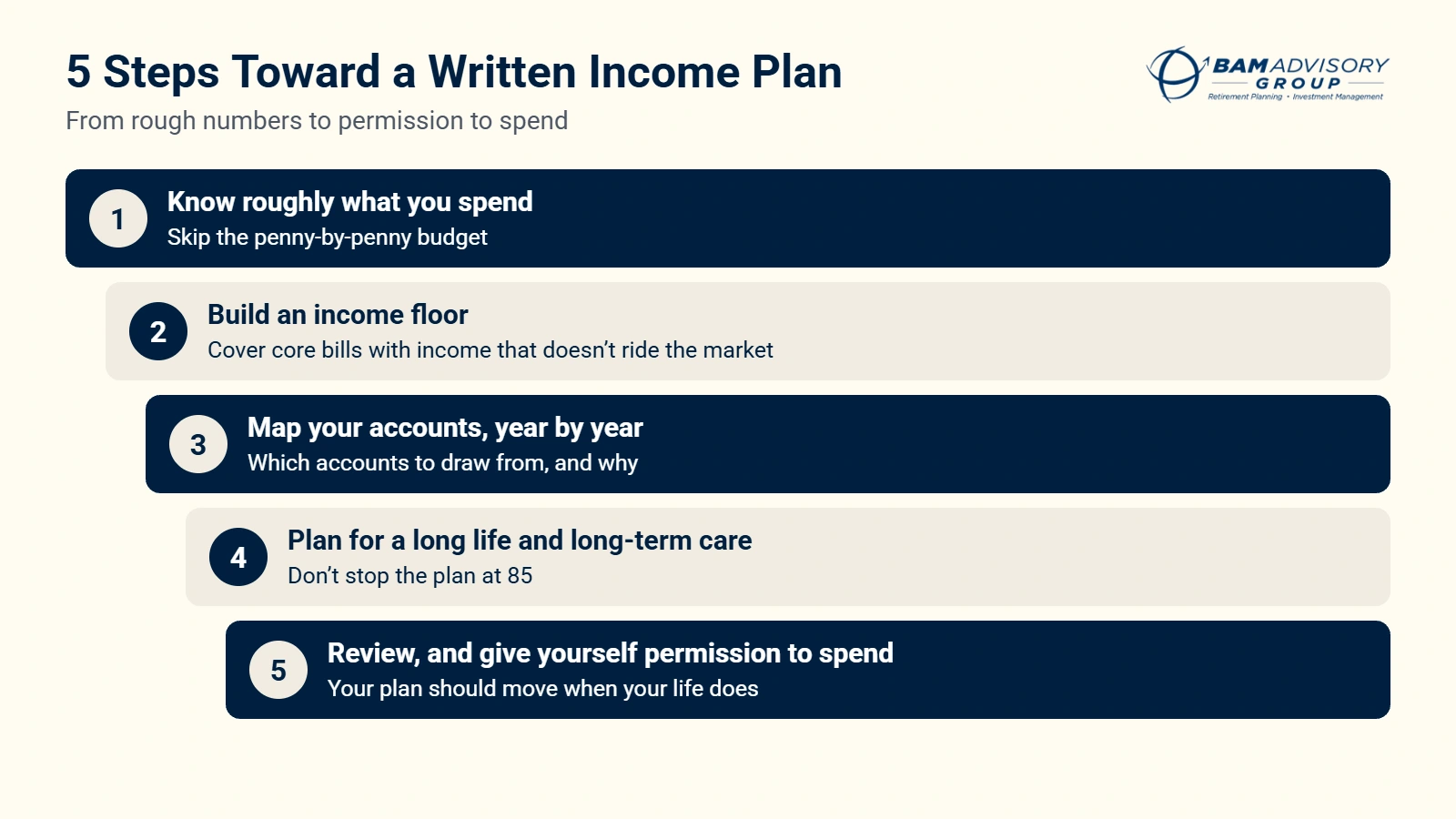
5 Steps to Help You Stop Worrying About Running Out of Money
Here are some tips to consider:
1. Know roughly what you spend
Skip the penny-by-penny budget.
Max used to hand clients a detailed budget worksheet.
People kept putting it off, and the ones who finished it often treated the total as a line they could never cross. So he changed course.
Now the first conversation is much simpler: “How much do you think you spend? About $5,000? Let’s create a plan designed to cover $5,000. If that’s not enough, or if it’s too much, we can dial it back or increase it.”
2. Build an income floor
Pay for the bills you can’t skip with income that doesn’t ride the market. Social Security, a pension, annuity income or high-quality bond interest can all do that job.
A market drop generally doesn’t pull that floor down with it. Our article on asset management in retirement shows how we split income from growth with three buckets.
3. Map which accounts you'll draw from, year by year
Max recently met clients with more than enough saved who still planned to keep working until Social Security.
His team laid the proposed plan out one year at a time: which accounts to draw from before Social Security started, which ones afterward, and why. The order came down to taxes.
"Once we are able to get very granular and show them pretty much the exact steps, like this is where you pull from, you're going to have enough when you turn 90, it clicks."
Max Ross
4. Plan for the possibility of a long life and long-term care
Many plans stop at 85. That’s often too early.
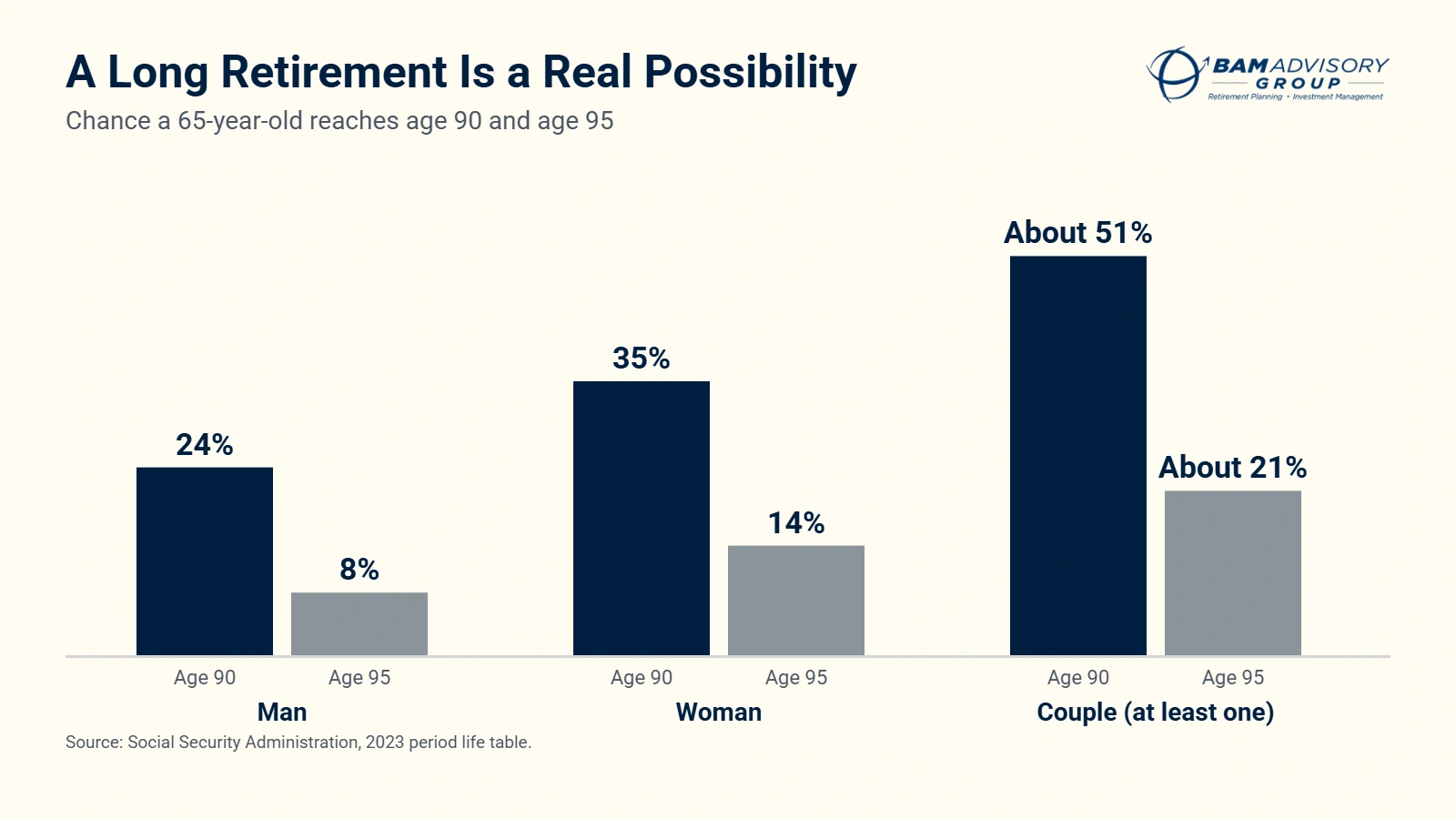
Based on Social Security’s 2023 life table, about 24% of men and 35% of women who reach 65 are expected to live to 90.
For a 65-year-old couple, the odds are about 51% that at least one of them gets there (Social Security Administration life table).
| Age 65 today | Chance of reaching 90 | Chance of reaching 95 |
|---|---|---|
| Man | 24% | 8% |
| Woman | 35% | 14% |
| Couple (at least one) | About 51% | About 21% |
The longer you live, the more likely you’ll need long-term care
Max calls it “one of the biggest potential risks to a retirement portfolio,” and he points out that Medicare does not cover long-term care.
But a plan for it, he says, “isn’t for the individual that’s going to need it. It’s for the family.” It can keep your kids from becoming your caregivers by default.
See our approach to long-term care planning.
5. Review the plan, and give yourself permission to spend
Your plan should change when your life does. Regular reviews show whether you’re ahead of schedule. If you are, you might treat that as permission to spend on the things that matter to you.
If This Sounds Familiar
Maybe you’ve saved well and still lie awake wondering whether it’s enough. A short conversation is a good first step.
Our team can create a plan that’s designed to show you, year by year, where your income will come from and how much you can spend with confidence. Every BAM Retirement Gameplan™ starts there, and it’s how we approach retirement planning in Denver.
For more complex situations, our guide to high net worth financial advice goes further.
Frequently Asked Questions
How many retirees actually run out of money?
It depends on how well they planned. Morningstar projected that 41% of U.S. households could run short of money in retirement once long-term care costs are factored in (Morningstar Center for Retirement & Policy Studies, 2025). Many retirees do the opposite, though: 65-year-old couples withdrew only about 2% of their savings a year, roughly half the commonly cited “4% rule” (Blanchett and Finke, “Retirees Spend Lifetime Income, Not Savings,” Financial Planning Review, 2025).
How do you not feel guilty about retiring?
Guilt often comes from uncertainty about whether you can afford it. Seeing a year-by-year plan that shows your income, taxes and savings through age 90 or beyond can help replace that guilt with confidence. It also helps to decide in advance what your money is for, such as travel, family or giving, so spending feels like the plan working.
What is financial anxiety disorder?
Financial anxiety isn’t a formal medical diagnosis. It’s a term for persistent worry about money that can affect sleep, decisions and relationships, even when finances are stable. A clear plan helps reduce the uncertainty behind much of that worry. If anxiety is affecting your daily life, it’s worth talking with a licensed mental health professional as well.
How much can I safely spend in retirement?
It depends on your savings, guaranteed income, taxes, health and how long your money needs to last. Rules of thumb like withdrawing 4% a year are a starting point but ignore taxes and market timing. A personalized income plan, stress tested for bad markets and a long life, may better help you understand what you can spend with confidence.
This article is for informational purposes only and should not be construed as a recommendation, or as financial, legal or tax advice for your particular circumstances.
¹ Social Security Administration, Office of the Chief Actuary, Period Life Table 2023 (2026 Trustees Report). Probability calculated as female survivors at age 90 divided by female survivors at age 65.

David began his financial services career in 1999 as an insurance account executive in Northern California. He expanded operations to Denver, Colorado in 2005, co-founding BAM Advisory Group alongside his wife, Kristy. With 25+ years of industry experience, David's expertise spans retirement income planning, Social Security maximization, estate planning, and tax mitigation.
inView all posts by David Afraimi →
Maxwell Ross is our Colorado native! His certifications include his Series 65 and Colorado Life & Health License. Having the ability to help reduce the stress and worry people feel about their financial futures is something Max truly sees value and inspiration in.
inMore from Max →Related Posts
Asset Management in Retirement
The three-bucket structure we use to help keep your income apart from market swings.
October 6, 2026

High Net Worth Financial Advice
When a basic plan stops being enough, and what changes past $500,000.
October 13, 2026

When Should You Start Financial Planning?
Why saving and planning are two separate jobs.
October 20, 2026