High Net Worth Financial Advice
Max Ross explains when a basic plan stops being enough, what changes past $500,000, and why wealth can still feel scarce.

Maxwell Ross is our Colorado native! His certifications include his Series 65 and Colorado Life & Health License.

High-net-worth financial advice is for people whose wealth has outgrown a simple save-and-invest approach.
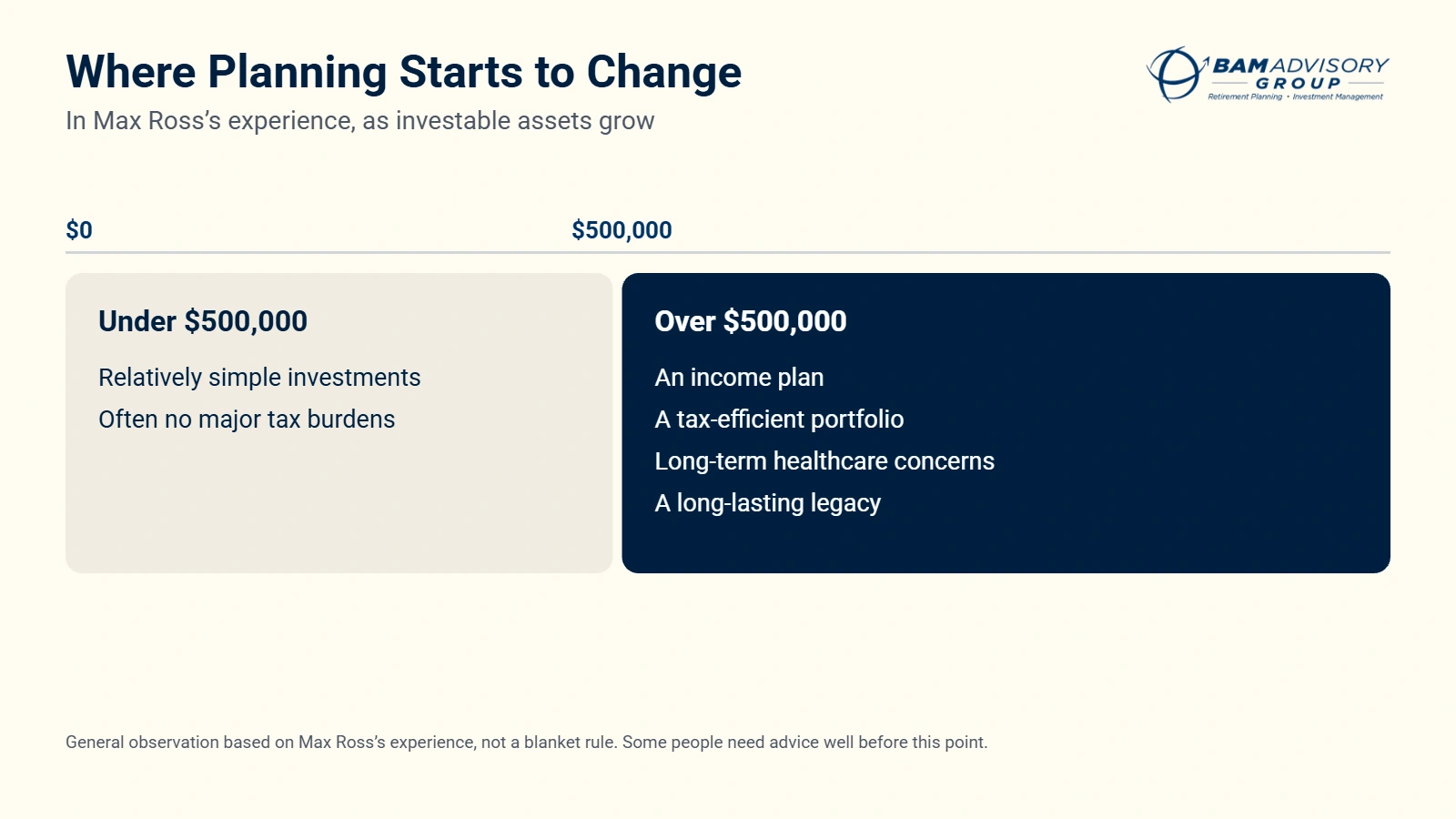
For many people, the shift starts around $500,000 in investable assets. Past that point, in Max’s experience, taxes, required minimum distributions, Social Security timing, healthcare, and legacy choices can move the outcome more than investment growth does.
Max Ross is our VP of Client Solutions and Advisor Development.
He’s worked with our clients since 2019, and we asked him when a basic plan runs out of road, which tax thresholds show up as wealth grows, and why so many people with more than enough still feel short.
- A basic plan often stops being enough once your decisions, and not only your returns, start driving results.
- Around $500,000 is where Max sees mistakes start to carry real costs.
- Several federal thresholds, from the 3.8% net investment income tax to Medicare's income surcharges, are tied to income that often comes from your investments.
- More wealth doesn't automatically end money worry. Max sees it move in stages.
- High-net-worth planning is never finished. It shifts every time your life does.
When Does a Basic Financial Plan Stop Being Enough?
For years, a basic plan does the job. You save steadily, buy diversified funds, and mostly leave them alone.
Then other things start pulling on the result, and investment growth stops being the only lever. Max calls that the turning point.
"All of a sudden, you're not just worried about accumulating your portfolio anymore. You're worried about every single decision you make and how it's going to impact your overall plan."
Max Ross
Each of those choices carries more weight than it used to.
In Max’s words, “one wrong decision can potentially cost you money in taxes, or reduce your legacy, or get rid of a bunch of money that you’ve been saving so long for.”
The $500,000 Line
There’s no official dollar amount that makes you “high net worth.”
The closest regulatory benchmark is the SEC’s accredited investor standard: a net worth over $1 million, not counting your primary residence, or income over $200,000 ($300,000 with a spouse) in each of the last two years (SEC, Investor.gov).
Max draws the planning line a good deal lower.
"Usually over $500,000 is when decisions that you're making can really cause impacts if they're made incorrectly."
Max Ross
He’s careful to say it isn’t a blanket rule. Some people need advice well before that point.
Seven-figure retirement savings are also rarer than people tend to assume.
In the Federal Reserve’s 2025 Survey of Consumer Finances, about 12.4% of households headed by someone age 55 to 64 had $1 million or more in retirement accounts, the highest share of any age group (Q3 Advisors analysis of the Fed’s 2025 SCF).
What a $1 Million Portfolio Needs That a $100,000 Portfolio Probably Doesn't
We asked Max what changes as a portfolio grows. Depending on how the money is set up, he said, it probably needs a well-thought-out tax plan.
"When you start crossing over that threshold and accumulating more wealth, taxes are going to play a bigger part in your plan than a lot of people realize."
Max Ross
A $100,000 portfolio usually isn’t carrying that kind of tax burden.
These federal thresholds start to matter as wealth and investment income grow.
| Threshold | What happens | 2026 level |
|---|---|---|
| Net investment income tax | An extra 3.8% tax on investment income above the threshold | Modified AGI over $200,000 (single) or $250,000 (married filing jointly) |
| Medicare IRMAA | Higher Medicare Part B premiums than the $202.90 standard monthly premium | Modified AGI over $109,000 (individual) or $218,000 (joint) |
| Required minimum distributions | Mandatory taxable withdrawals from pre-tax accounts, with a 10-25% excise tax on amounts not taken | Generally begin at age 73 |
| Federal estate tax exclusion | Estates above this amount may owe federal estate tax | $15,000,000 per person |
| Annual gift exclusion | Gifts above this amount per recipient require a gift tax return | $19,000 per recipient |
You can plan around any of these.
They also bump into each other. A large IRA withdrawal or Roth conversion in the wrong year, for example, can push your income over a Medicare threshold, with higher premiums arriving two years later.
Good planning spots those collisions early. See how we approach tax planning.
Why Some Wealthy People Still Feel Like They Don't Have Enough
Plenty of Max’s clients have built real wealth. Many still decide things as if they had far less.
"They're the people who were raised by parents who came from the Great Depression and were taught to be frugal with their money, and they don't really realize, I have enough."
Max Ross
Getting someone past that is one of his favorite parts of the job.
When it finally lands, people book the trip they’d been putting off. Some give more to charity or help a grandchild with a car or a first house.
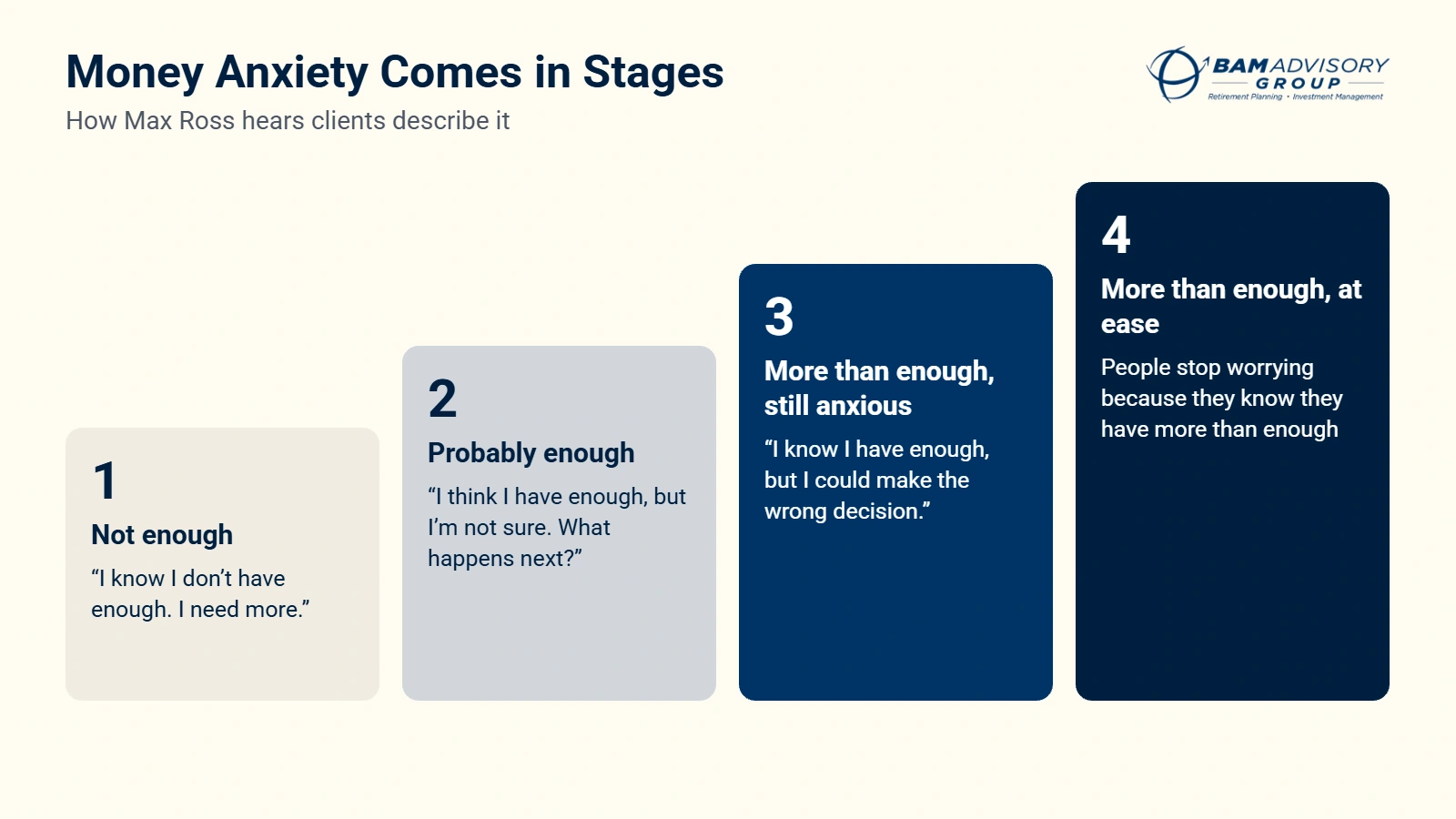
Money anxiety, as Max describes it, comes in stages.
| Stage | What it sounds like |
|---|---|
| 1. Not enough | "I know I don't have enough. I need more." |
| 2. Probably enough | "I think I have enough, but I'm not sure. What happens next?" |
| 3. More than enough, still anxious | "I know I have enough, but I could make the wrong decision." |
| 4. More than enough, at ease | People stop worrying because they know they have more than enough |
An inheritance doesn’t always end the worry either.
Max watched one client go from an extremely frugal lifestyle to inheriting more than they could ever spend. “They took one anxiety for another. Now it’s, I have too much money. What do I do now?”
With clients like that, he says, the hardest conversation is often just telling them it’s okay to go buy the car.
So his team does something to help clients feel more confident in their retirement.
"Our team definitely loves to tell people to spend more money, which is maybe counterintuitive to the industry as a whole."
Max Ross
There’s a time limit, too. In Max’s experience, health often slows people down before their money does.
If this sounds familiar, our guide on how to stop worrying about running out of money in retirement goes deeper.
What High Net Worth Financial Advice Should Cover
Good high-net-worth advice ties together decisions that are sometimes handled one at a time, often by different people. At BAM, they live in one plan, the BAM Retirement Gameplan™, which covers:
- Income planning: which accounts you draw from, in what order, and when to claim Social Security or a pension.
- Tax-efficient investing: which account holds each investment, plus tactics like tax-loss harvesting.
- Required distribution planning: getting ahead of RMDs before they push you into a higher bracket or a Medicare surcharge.
- Long-term care: a plan to pay for care, so the cost doesn't fall on your family. See our long-term care planning.
- Legacy: beneficiaries, a will and powers of attorney* that reflect what you actually want. See our estate and legacy planning.
- Ongoing reviews: changes as your income, your goals and the tax rules move.
*Legal and estate planning services are performed by qualified legal and tax advisors. BAM does not provide legal advice or services.
Planning Is Never One and Done
We asked Max what he wishes every client understood before a first meeting. He didn’t talk about returns.
"Planning is not a one-time thing. It is an ongoing, ever-changing, never-stop process."
Max Ross
Asked what he’d change about how people think about money, Max kept it simple: “Money is a tool. It’s not your life. It’s not who you are. It’s there to help support the lifestyle you want and bless the people you love.”
See What Your Wealth Could Do With a Plan Behind It
If you’ve built real wealth but aren’t sure your plan has kept pace, a conversation with our team can show what you may be missing on taxes, income, and legacy, and how much you may be able to spend with confidence.
Learn more about working with a high net worth financial advisor at BAM, or see how we approach retirement planning in Denver.
Frequently Asked Questions
What is considered high net worth for financial advisors?
There’s no single definition. A common reference point is the SEC’s accredited investor standard: $1 million in net worth, not counting your home. In practice, planning complexity often starts sooner. At BAM, we see taxes and income decisions carry real costs once investable assets pass about $500,000.
Do high-net-worth individuals use financial advisors?
Many do, because the decisions get more complex as wealth grows. Taxes on investment income, required minimum distributions, Medicare surcharges, Social Security timing and estate planning all interact. A good advisor coordinates those decisions in one plan, rather than managing investments in isolation and leaving taxes and income for you to figure out.
At what net worth should you get a financial advisor?
It depends on how complex your situation is and how involved you want to be. From Max Ross’s experience, once investable assets pass about $500,000, mistakes on taxes, withdrawals and risk start to have a meaningful cost. You may want help sooner if you’re within 10 to 15 years of retirement or your income has risen sharply.
What does a financial advisor actually do for high net worth clients?
A good one coordinates the decisions that get harder as wealth grows: which accounts to draw from and when, how to manage taxes and required distributions, when to claim Social Security, how to plan for long-term care, and how to pass wealth on. In Max Ross’s view, the job is helping you know what happens next, not just reporting returns.
This article is for informational purposes only and should not be construed as a recommendation, or as financial, legal or tax advice for your particular circumstances.

David began his financial services career in 1999 as an insurance account executive in Northern California. He expanded operations to Denver, Colorado in 2005, co-founding BAM Advisory Group alongside his wife, Kristy. With 25+ years of industry experience, David's expertise spans retirement income planning, Social Security maximization, estate planning, and tax mitigation.
inView all posts by David Afraimi →
Maxwell Ross is our Colorado native! His certifications include his Series 65 and Colorado Life & Health License. Having the ability to help reduce the stress and worry people feel about their financial futures is something Max truly sees value and inspiration in.
inMore from Max →Related Posts
Asset Management in Retirement
The three-bucket structure we use to help keep your income apart from market swings.
October 6, 2026
When Should You Start Financial Planning?
Why saving and planning are two separate jobs.
October 20, 2026
How Can You Stop Worrying About Running Out of Money in Retirement?
Five steps that can help you trade uncertainty for a written income plan.
October 27, 2026